A research team from the Institute of Geochemistry of the Chinese Academy of Sciences (IGCAS), together with collaborators from the University of Chinese Academy of Sciences, the University of Bayreuth, China University of Geosciences (Wuhan), and Okayama University, has shown that the mantle transition zone may act as an important barrier to large-scale water transport into the lower mantle. Their study, published in Communications Earth & Environment on March 25, indicates that under low water activity conditions, dense hydrous magnesium silicates are unlikely to form extensively in subducting slabs, limiting their role as major water carriers to greater depths.
Water plays a central role in controlling the physical and chemical properties of Earth’s deep interior. One of the long-standing questions in deep Earth science is how water is stored in subducting oceanic slabs within the mantle transition zone, between about 410 and 660 kilometers depth, and whether dense hydrous magnesium silicates can efficiently transport water into the lower mantle. Although previous studies often emphasized the importance of these hydrous minerals, most experimental constraints were obtained under water-saturated conditions, which differ markedly from the relatively dry conditions expected in natural slabs.
To address this issue, the team conducted high-pressure and high-temperature experiments in the MgO-SiO2-H2O system at 16 and 21.5 GPa and 1400 K, using starting materials with bulk water contents from 0.1 to 5 wt% H2O. By combining phase equilibrium experiments, electron backscatter diffraction, micro-focused X-ray diffraction, NanoSIMS water-content measurements, and mass balance calculations, they systematically evaluated how water is partitioned among mantle minerals under transition-zone conditions.
The results show that when bulk water content is below a critical threshold of about 1.22 wt%, water is stored mainly in wadsleyite and ringwoodite rather than in dense hydrous magnesium silicates (Figure 1). At 16 GPa, phase E appears only when the bulk water content exceeds 1.22 wt% H2O. At 21.5 GPa, superhydrous phase B forms only after ringwoodite approaches water saturation, with a corresponding threshold near 1.30 wt% H2O. These observations demonstrate that water preferentially enters nominally anhydrous mantle minerals in the transition zone, and that hydrous magnesium silicates form only after those minerals become water saturated.
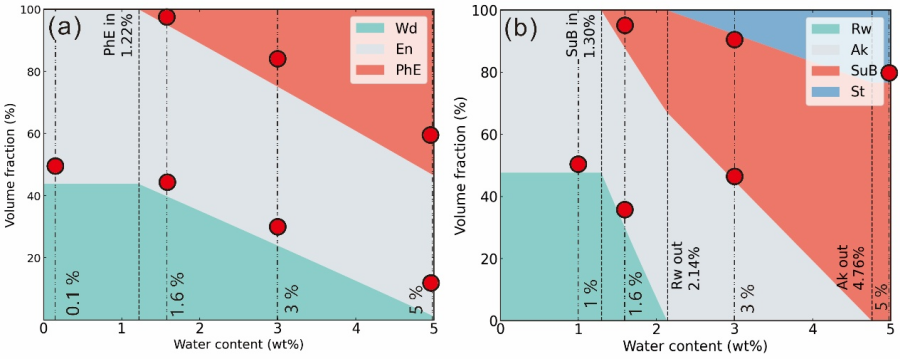
Figure 1. Mass balance calculation and experimental result of the phase volumes in low water content conditions. Wd: wadsleyite, Rw: ringwoodite, Ak: akimotoite, SuB: super hydrous phase B, St: stishovite, En: enstatite, PhE: phase E(Image by IGCAS)
The study also highlights the importance of water activity in controlling hydrous mineral stability. The authors point out that in natural mantle environments, where H2O may coexist with CO2 or hydrous melt, water activity can be significantly lower than in a pure-H2O system. Under such conditions, the effective threshold for stabilizing dense hydrous magnesium silicates may be even higher, further reducing the likelihood that these phases form extensively in real subducting slabs.
These findings have important implications for the deep Earth water cycle. Even in relatively cold and water-rich subduction zones, the bulk water content retained in slabs is commonly estimated to remain below the threshold required for widespread stabilization of dense hydrous magnesium silicates. As a result, water in the mantle transition zone is more likely to be hosted mainly by hydrous wadsleyite and ringwoodite. When slabs descend beyond the 660-km discontinuity, breakdown of hydrous ringwoodite may release water and promote melt formation, while only a limited amount of water may continue into the lower mantle through highly stable hydrous phases such as Al-rich phase D, phase H, and hydrous stishovite (Figure 2).
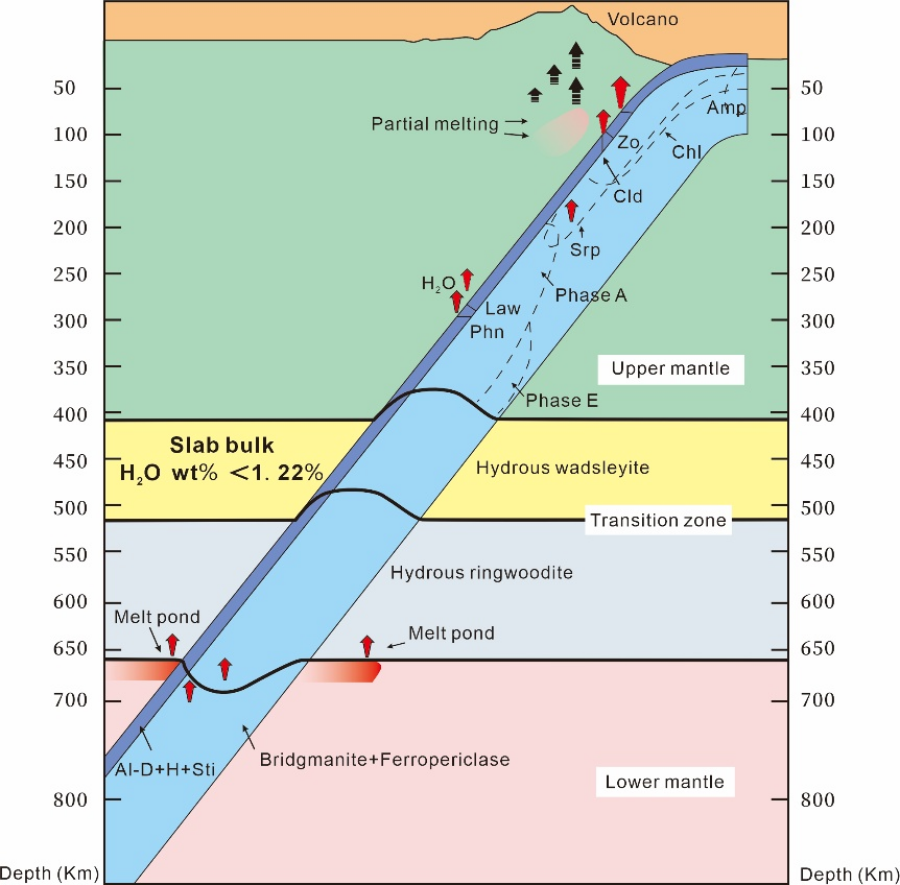
Figure 2. Graphical depiction of hydrous phase stability in descending slabs with H2O contents below the critical threshold. Amp: amphibole, Chl: chlorite, Zo: zoisite, Cld: chloritoid, Srp: serpentine, Law: lawsonite, Phn: phengite, Al-D: Al-bearing phase D(Image by IGCAS)
This work challenges the traditional view that dense hydrous magnesium silicates are the principal large-scale water carriers through the mantle transition zone. Instead, it suggests that large-scale water recycling may be largely restricted to depths shallower than around 660 km, providing new insight into the storage and transport of water in Earth’s interior.
Contact:
GUO Xinzhuan
Institute of Geochemistry, Chinese Academy of Sciences
Email: gxzhuan@mail.gyig.ac.cn
(By Prof. GUO Xinzhuan’s group)


