The cycling process of water within Earth’s interior constitutes a key to understanding the evolution of Earth and the formation of its habitability. While subducting slabs are known to transport water into the mantle, it has long been assumed that most hydrous minerals dehydrate at high temperatures, releasing fluids during their descent. Whether water can survive under the extreme conditions of the deep lower mantle, however, has remained an open question.
A research team from the Institute of Geochemistry of the Chinese Academy of Sciences and Guizhou Normal University, together with international collaborators, has now provided new insights into this problem using a combination of ab initio and deep-learning potential molecular dynamics simulations. Their study shows that under lower-mantle and core–mantle boundary (CMB) conditions, water and the key hydrous minerals of δ-AlOOH will enter a superionic state, fundamentally altering their stability and dehydration behavior. The findings were published in Science Advances.
The simulations reveal that liquid water is thermodynamically unstable in the deep lower mantle and instead freezes into superionic ice phases, in which hydrogen ions diffuse rapidly through an oxygen lattice. At the same time, the hydrous mineral δ-AlOOH undergoes a remarkable “double superionic transition” at CMB of pressures around 140 GPa and temperatures near 3800 K, characterized by highly diffusive hydrogen and aluminum ions. This enhanced ionic mobility contributes substantial entropy, stabilizing the crystal structure and raising its melting temperature to values comparable to those at the CMB.
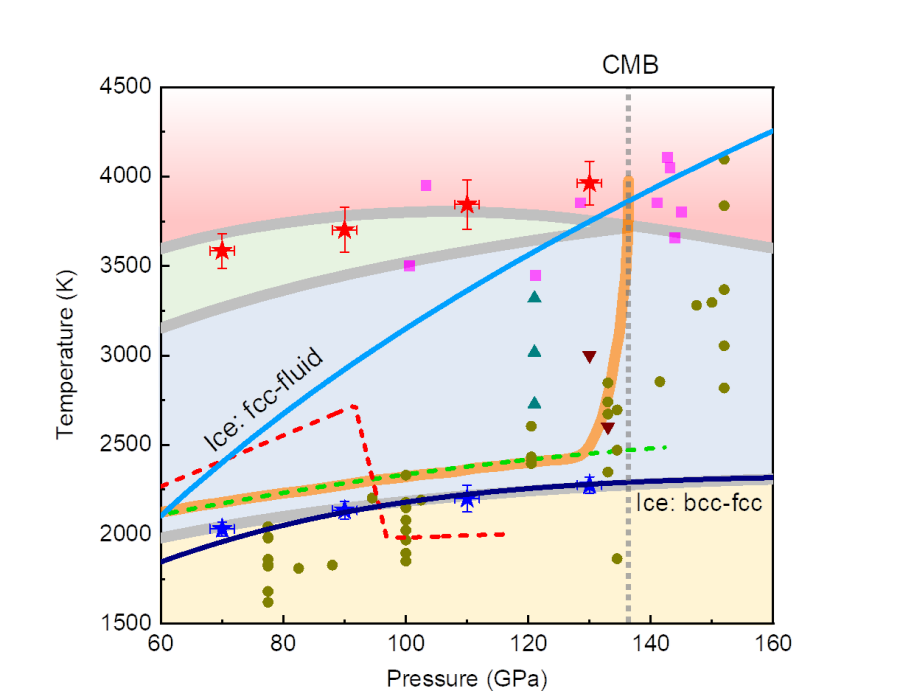
Fig. 1. Phase diagram of AlOOH and H₂O under high-temperature and high-pressure conditions (60–160 GPa, 1500–4500 K): superionic transition enhances the stability of hydrous phases, enabling the existence of AlOOH and H₂O in the form of superionic state in the lower mantle (the orange line denotes the geotherm).(Image by IGCAS)
Free-energy calculations further demonstrate that dehydration of δ-AlOOH becomes both energetically and kinetically unfavorable under deep-mantle conditions. Because water exists as superionic ice rather than a free fluid, the conventional dehydration mechanism is effectively suppressed. As a result, water from early stage of Earth or carried into the mantle by subduction may be preserved over geological timescales, accumulating as a long-term water reservoir near the base of the mantle.
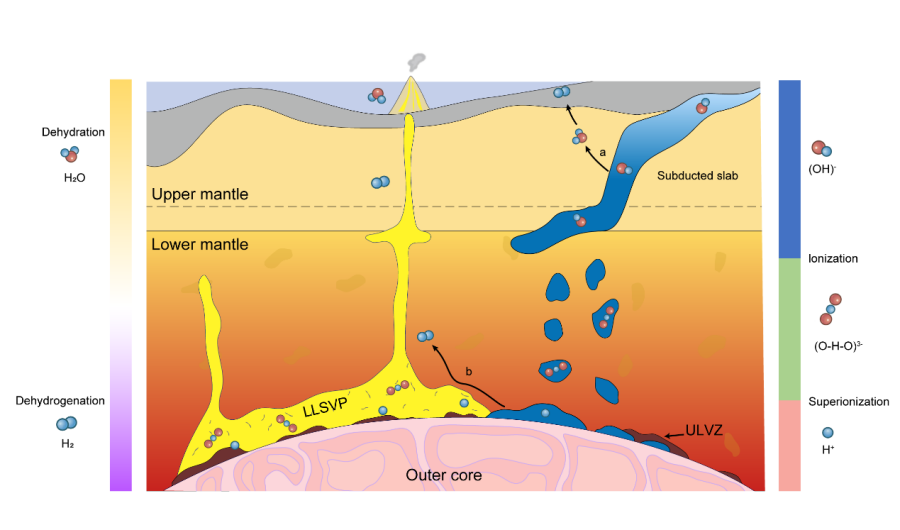
Fig. 2. Deep Earth Water Cycle: With increasing depth, the occurrence state of water undergoes a sequential transition from hydroxyl-bound state (dominated by covalent bonds) to symmetric ionized state (governed by ionic bonds) and finally to superionic state (characterized by disordered proton distribution).(Image by IGCAS)
By revealing how the physical state of water controls dehydration in Earth’s deep interior, this study provides a new framework for understanding deep water cycling, the nature of lowermost mantle structures, and the long-term storage of ancient water and hydrogen within the planet.
This work elucidates the mechanism by which the physical state of water governs dehydration processes in Earth’s deep interior, thereby establishing a novel conceptual framework for understanding deep volatile cycling, the geophysical and geochemical nature of lowermost mantle heterogeneities, and the long-term sequestration of primordial water and hydrogen within the planet.
Contact:
HE Yu
Institute of Geochemistry, Chinese Academy of Sciences
Email: heyu@mail.gyig.ac.cn
(By Prof. HE Yu’s group)


